
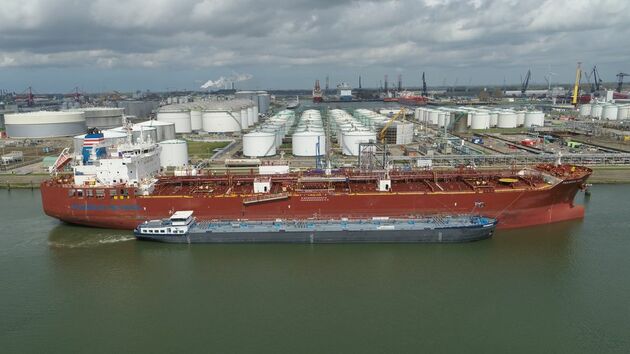
The world’s first bunkering of methanol by a bunker vessel took place in Rotterdam.
The “Takaroa Sun” is the first methanol-powered vessel to have been supplied by a commercial bunker vessel. This took place in May 2021.
Five years later, an article on the UK P&I Club’s website about methanol caught our attention. In summary, this article tells us the following.
Methanol
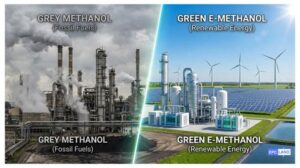
Methanol is a key player in the short-term strategy for decarbonizing the shipping industry, thanks to a century of experience in production, storage, and transport. As a liquid at room temperature and pressure, it is easier to handle than cryogenic or pressurized fuels such as hydrogen or ammonia. Methanol is already widely used as a chemical feedstock, solvent, and fuel, which simplifies knowledge about safety, compatibility, and storage. However, its carbon footprint remains a challenge: most of the global supply is still fossil-based (grey methanol). The availability of bio-methanol and e-methanol is growing, with the first bunkering of bio-methanol in 2023 and e-methanol from 2025.
Infrastructure and Adoption
Methanol integrates more smoothly with existing ship and port infrastructure than alternatives like ammonia. Retrofitting conventional vessels is technically feasible and relatively cost-effective, requiring fewer modifications to engines and tanks. This explains its growing adoption: methanol-capable ships now account for 8-10% of the global order book for alternative fuels and 14-17% within container shipping. Maersk is leading the way with vessels like the LAURA MÆRSK and a target of 19 methanol-capable ships by 2026. Other major operators, including OOCL, Hapag-Lloyd, and NYK (with the GREEN FUTURE), are also investing in methanol. However, methanol’s lower energy density means ships need to refuel more frequently, making the availability of bunkering infrastructure critical.
Safety and Regulation
Methanol is toxic and has a low flash point (12°C), posing risks during handling and bunkering. Fire and explosion hazards are mitigated by specialized tanks, nitrogen inerting, double-walled piping, and strict control of ignition sources, as outlined in IMO guidelines. Training for crews is under development, with a focus on safety for alternative fuels. Although methanol dissolves quickly in water and evaporates, the invisibility of its flames (especially in daylight) presents a detection and firefighting challenge.
Environmental Impact
In the event of a spill, methanol spreads rapidly across the water surface, dissolves, and evaporates without forming a persistent slick. Its half-life in water is 1-7 days, primarily due to biodegradation and volatilization. While methanol is less toxic than ammonia, it can still harm fish and microorganisms. However, in open seas, tides, wind, and waves quickly dilute concentrations to safe levels, making its environmental impacts generally short-lived.
Conclusion
Methanol offers practical advantages for shipping, but scaling up depends on the availability of low-carbon methanol, the expansion of bunkering infrastructure, and safe operational protocols. With the right measures, methanol can play a key role in the maritime energy transition.
Courtesy UK P&I Club.
Photo: Port of Rotterdam