
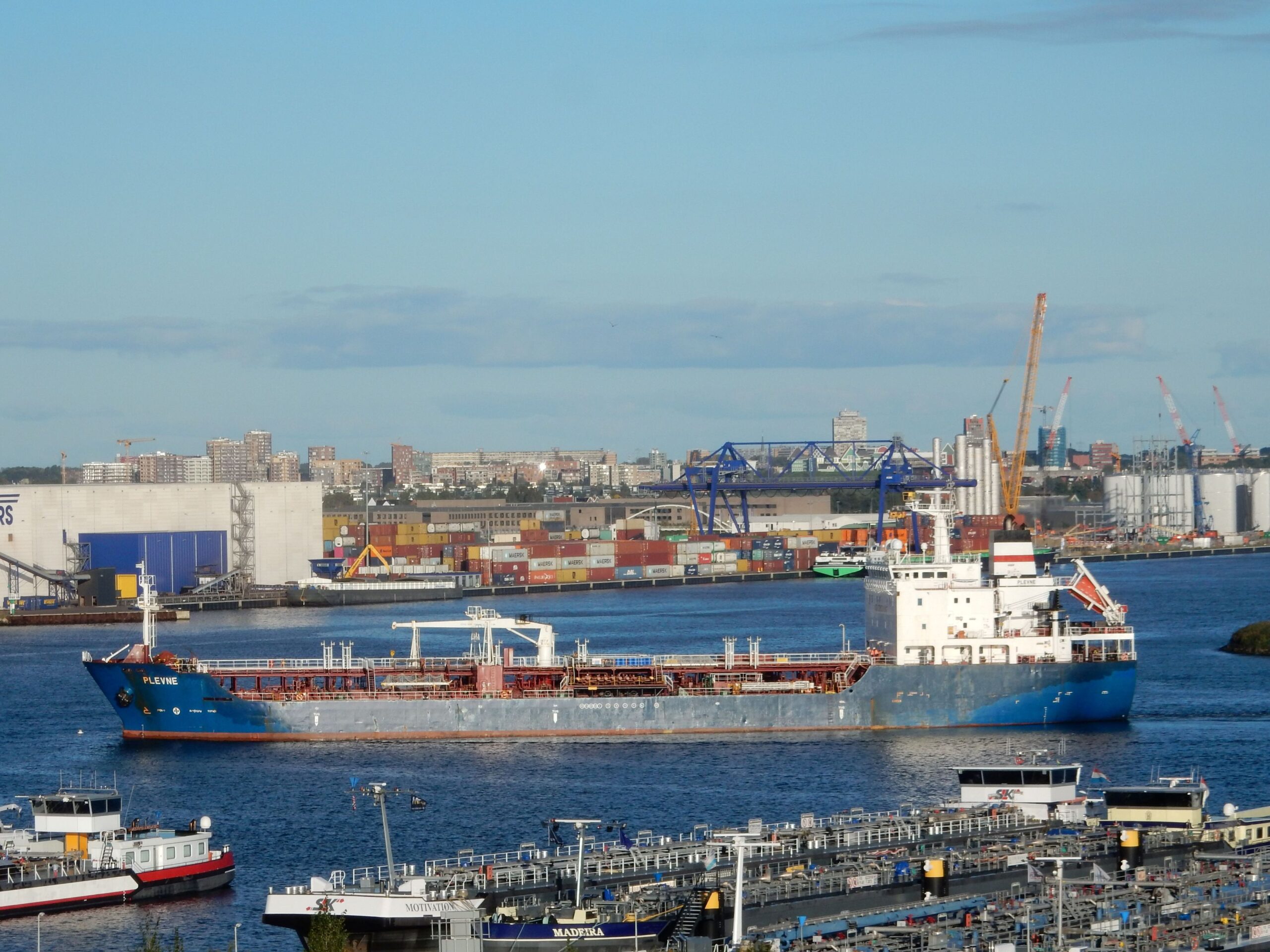
This article highlights the most significant developments in Dutch seaports during the first eight months of 2026.
Northern ports
Eemshaven is evolving into a strategic energy and industry hub for Northern Netherlands, focusing on offshore wind, hydrogen production, energy infrastructure, and sustainable industry. The port plays a pivotal role in the energy transition, particularly in landing energy generated by North Sea wind farms. One third of the future wind energy produced in the Dutch part of the North Sea will come ashore in Groningen (Eemshaven).
In Harlingen, the Zuiderpier is being extended and a dam is being relocated to make the port safer and more accessible. This aligns with international safety standards and improves access for vessels. Harlingen has also commissioned new RoRo facilities for short-sea connections with Scandinavia and the Baltic States, in response to the halving of fishing activities in recent years. This could help future-proof the port.
Work is underway to reorganize the infrastructure in and around the port of Den Helder to improve accessibility to the port area. Den Helder also plays a key role in offshore energy (wind at sea, hydrogen) and, as the home port of the Royal Dutch Navy, in ensuring national and international security.
North Sea Canal Area
The number of vessels calling at the Port of Amsterdam increased, and the port authority issued more land, resulting in a net profit rise of nearly € 9 million, despite cargo throughput remaining almost unchanged.
Hyundai GLOVIS is establishing its first European hub in Amsterdam for the import, export, and distribution of vehicles, in collaboration with Koopman Logistics Group and Port of Amsterdam. From 1 January 2027, Hyundai GLOVIS will use 47 hectares of land in the Amsterdam port.
Rhine and Meuse Estuary
In the Port of Rotterdam, cargo throughput increased by 0.4% in the first half of 2026 compared to 2025, reaching 212 million tons. Net profit rose by 0.9% to € 144.8 million. A total of € 126 million was invested in port development.
As of 15 August 2026, hundreds of port companies will fall under the new Cybersecurity Act (Cbw) and the Resilience of Critical Entities Act (Wwke), implementing the EU’s NIS2 and CER directives. This requires registration, a duty of care, and reporting of significant cyber incidents. This, of course, also applies to companies in other Dutch ports.
In the Rotterdam port, companies, emergency services, and authorities are increasingly using drones for inspections, security, environmental monitoring, and incident response. This requires a safe and well-organized low-altitude airspace.
As of 1 January 2026, the port of Moerdijk is better connected to the Rhine and Meuse, the two most important waterways in the Netherlands. This directly links Moerdijk to all inland waterway routes to the European hinterland.
Scheldt Basin
The merged port North Sea Port (Ghent, Terneuzen, Vlissingen) has grown for the second consecutive year, mainly due to a significant increase in trade with Canada. The port is investing in safety and preparing for larger military transports.
Belgium and the Netherlands are working on a cross-border freight rail link between Ghent and Terneuzen, the so-called “missing link.”
General trends in shipping movements
Total throughput in the Port of Rotterdam increased by 0.4% in the first half of 2026, despite geopolitical tensions such as the closure of the Strait of Hormuz. This indicates a stable to slightly growing number of ship movements, especially for container traffic (deep sea +13% to North America, +8% imports from Asia) and liquid bulk (crude oil, mineral oil products).
In container throughput, the volume measured in TEU decreased by 0.1%, but tonnage fell by 2.6% (98.5 million tons). This suggests a shift toward larger vessels (fewer movements, more cargo per ship).
The aforementioned use of drones for inspections, security, and environmental monitoring can improve the efficiency of ship movements. However, this also requires the introduction of new regulations for the use of airspace.
In Amsterdam, a growing number of vessels called at the port, despite throughput remaining almost unchanged. This suggests an increase in ship movements, possibly in short-sea traffic.
The arrival of Hyundai GLOVIS (European hub for vehicles) from 2027 is expected to lead to additional ship movements for import, export, and distribution.
Thanks to the New Lock, large offshore vessels can also reach Amsterdam, frequently for maintenance and modifications. This has limited impact on the number of ship movements.
Due to improved connections to the inland waterway network, Moerdijk has seen an increase in inland shipping movements. The open connection to the sea and the freedom to choose between rail, road, pipelines, and inland waterways make Moerdijk attractive for transshipment, which could lead to more ship movements for transmodal cargo handling.
The growth of North Sea Port (Vlissingen, Terneuzen, Ghent) has also led to an increase in ship movements, particularly for the transport of dry and liquid bulk (coal, iron ore, oil products).
The new locks in Terneuzen allow larger sea vessels to enter. This could result in fewer ship movements (fewer small vessels needed), but more cargo per movement.
The new RoRo facilities for short-sea connections with Scandinavia and the Baltic States in the port of Harlingen will lead to an increase in ship movements for roll-on/roll-off vessels.
In Den Helder, the development of the maritime cluster is expected to increase the number of ship movements, especially for offshore support vessels and naval ships.
NNPC Correspondents continues to monitor developments in all Dutch seaports. We are ready to provide information to shipowners, charterers, and their P&I Clubs and insurers, or to assist with emergencies or maritime claims.
We collected information from numerous sources.