
correspondents@nnpc-correspondents.nl+31 (0)85 48 33 121
    NNPC Correspondents logo whiteNNPC Correspondents logo white
    • What we do
    • About us
    • Insights
    • Contact
    Search
    START TYPING AND PRESS ENTER TO SEARCH
    • What we do
    • About us
    • Insights
    • Contact
    Search

    Tank washing at sea

    8th April 2026
    CharterersDutch lawEnvironmentLiquidcargoMARPOLShipownersTankers

    In Dutch, the term ‘zeezwaaien’ refers to the process whereby a tanker leaves a Dutch port to head out to sea for the purpose of washing its tanks, and then returns to that port to receive its next cargo.

    ‘Zeezwaaien’ occurs when a ship leaves the port after unloading a chemical cargo, with the sole purpose of washing small quantities of cargo residues from the tank in the Exclusive Economic Zone (EEZ, beyond the 12-nautical-mile zone), discharging the wash water into the sea and then returning to the port. A deliberate detour may also be made ‘en route’ to the next port.

    Investigation

    The Dutch authorities have limited insight into the extent to which tank washing occurs in the Dutch EEZ. Aerial and satellite observations do not provide comprehensive coverage.

    In 2020, the Dutch Inspectorate (ILT) identified, based on vessel movements and routes, 45 voyages by chemical tankers that could indicate ‘sea washing’. There is no reason to believe that this situation has changed significantly in recent years.

    Ships are only permitted to wash tanks (‘sea washing’) under certain conditions. These rules are set out in Annex II of the International Convention for the Prevention of Pollution from Ships (MARPOL).

    Ruling of the Supreme Court

    In 2014, the Dutch Supreme Court issued a ruling on the interpretation of the legislation and the conditions under which wash water may be discharged into the sea. Article 29 of the Decree on the Prevention of Pollution by Seagoing Ships (a Dutch regulation) includes a prohibition on discharging substances into the sea other than in accordance with Annex II to MARPOL. This concerns a clarification of the term ‘en route’ from Annex II to MARPOL.

    The Dutch Supreme Court has concluded that ‘sea washing’ falls under the term ‘en route’ and that this method of tank washing is permitted under Annex II of MARPOL. A ship may leave a port or deviate from its route for the sole purpose of discharging cargo residues, provided that the discharge requirements set out in Annex II of MARPOL are met.

    No change in Dutch regulations

    In recent years, the Dutch government has investigated the possibility of restricting tank washing at sea. Based on the findings, it was decided not to introduce a national ban on ‘sea washing’. This was set out in a letter from the Minister of Infrastructure and Water Management to the House of Representatives of the Dutch Parliament dated 17 June 2024.

    The washing of ship’s tanks at sea is and remains subject to strict conditions in accordance with the MARPOL provisions.

    The tanks must have been pre-washed. Washing water may only be discharged if the vessel has a minimum speed of 7 knots. Discharge is only permitted at a distance of at least 12 nautical miles from the coast and in an area where the sea has a minimum depth of 25 metres.


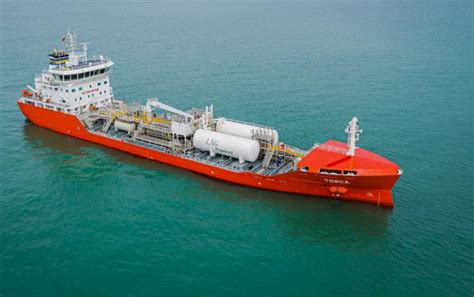
    Photo: a chemical tanker, not related to this article.

    Previous Post
    Impact of excise duties and VAT on bunker costs in Dutch ports

    LATEST INSIGHTS

    Impact of excise duties and VAT on bunker costs in Dutch ports

    30 March 2026

    New Dutch fuel transition rules for marine fuels

    10 March 2026

    Update to the Dutch Shipping Act

    25 February 2026

    5 years of NNPC Correspondents: 2021-2026

    19 February 2026

    Rotterdam port vision 2050*What does it mean for visiting ships?

    3 February 2026

    NEWSLETTER

    Sign up for our newsletter.
    Read more

    NNPC correspondents logo diap footer

    NNPC Correspondents B.V.
    Vasteland 12 E
    3011 BL Rotterdam
    The Netherlands

    CONTACT

    Phone: +31(0)85 483 31 21
    E-mail: correspondents@nnpc-correspondents.nl

    QUICK LINKS

    • What we do
    • About us
    • Insights
    • Our newsletter
    • Contact

    FOLLOW US ON

    © 2025 NNPC Correspondents B.V. – All rights reserved | Privacy & cookies

    Manage Cookie Consent
    To provide the best experiences, we use technologies like cookies to store and/or access device information. Consenting to these technologies will allow us to process data such as browsing behavior or unique IDs on this site. Not consenting or withdrawing consent, may adversely affect certain features and functions.
    Functional Always active
    The technical storage or access is strictly necessary for the legitimate purpose of enabling the use of a specific service explicitly requested by the subscriber or user, or for the sole purpose of carrying out the transmission of a communication over an electronic communications network.
    Preferences
    The technical storage or access is necessary for the legitimate purpose of storing preferences that are not requested by the subscriber or user.
    Statistics
    The technical storage or access that is used exclusively for statistical purposes. The technical storage or access that is used exclusively for anonymous statistical purposes. Without a subpoena, voluntary compliance on the part of your Internet Service Provider, or additional records from a third party, information stored or retrieved for this purpose alone cannot usually be used to identify you.
    Marketing
    The technical storage or access is required to create user profiles to send advertising, or to track the user on a website or across several websites for similar marketing purposes.
    Manage options Manage services Manage {vendor_count} vendors Read more about these purposes
    View preferences
    {title} {title} {title}